Stay
Visit a locality browsing the menu on the left. In each Italy area you can then choose the best touristical structures we are proposing.
Most viewed in
Italy
-
Sunland since 1979 is the leading tour operator for ground hanling services on Amalfi Coast, Cilento and Neapolitan Riviera. Sunland is the partner of some of the biggest tour operator world wide. Our attentive staff is at your service for: Hotel accomodation...
-
The Amalfi Coast, suspended between sea and Sky, is a land of an amazing beauty. Our wish, having the pleasure to be your driver/guide, is to share with you the traditions, art, history, landscapes and the beauty that makes this land, " The Divine Amalfi...
-
Self-catering villas and apartments on the Amalfi Coast with pool, access to the sea and air conditioning. Amalfi Vacation owns and manages all the Amalfi Coast villas shown on the website. We are specialists in luxury villas and self-catering apartments...
-
Located on the famous AmalfiCoast drive, a few minutes from the famous town of Amalfi, the Santa Caterina enjoys a panoramic coastal setting of incomparable beauty. The history of this special resort is as impressive as its surroundings. In 1880, Giuseppe...
-
Situated on the last bend of Amalfi's promenade and beach, this hotel is on four levels. Bright and Mediterranean in style, the Marina Riviera is a converted old noble villa. All rooms are spacious & tastefully furnished, and have open windows or balconies...
Print this page
Send to a friend by e-mail
Canovella de' Zoppoli
-
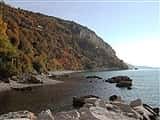
Canovella de'Zoppoli can only be reached by boat or on foot, by taking the panoramic track which has been used for centuries by fishermen from the Carso plateau who clambered down the embankment to launch their nets from the primitive wooden boats - the Zoppoli - that give their name to the area. From Aurisina or from the coastal road if you want to shorten the distance, you walk down through first a wood and then an area of terraces laboriously dug into the hillside, some stretches of the walk giving splendid views over the Gulf. Finally you arrive at a small harbour with showers, toilets and a restaurant at the side of which starts the stony path leading to the free-access beach which is very popular in summer, not least for all-night parties. The bathing area is sheltered and quiet and by walking along the sandy shore for a further ten minutes you can come to the naturalist beach of Liburnia in an area that is reminiscent of Puglia in the south of Italy, Corsica or some of the rocky Greek islands.
Point of interest
The Zoppolo, a boat used for centuries along the Trieste coastline, was a simple, primitive boat dug out of a single tree-trunk so it had a solid hull which was ideal for dragging over the rocky beaches without moorings or harbours where the Carso meets the sea. It was used by the local peasants for fishing or to reach otherwise inaccessible costal farmland.